TerraGrid Pro Biaxial Geogrid
by Geoworks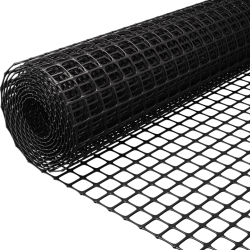
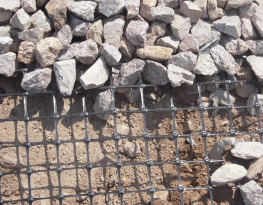
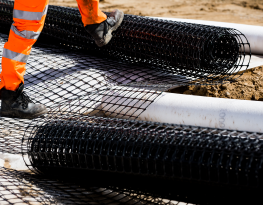




TerraGrid Pro is a high-performance biaxial geogrid developed to deliver reliable reinforcement in civil engineering and infrastructure projects. Manufactured from polypropylene, its rigid, open structure allows aggregates to interlock effectively, creating a mechanically reinforced layer that improves load distribution and extends the life of the pavement or platform.
The biaxial configuration provides strength in both longitudinal and transverse directions, making TerraGrid Pro well-suited to applications where traffic loading is variable and stresses occur across multiple axes. Typical uses include road and rail construction, car parks, working platforms, haul roads and other heavily trafficked areas. By reinforcing the aggregate layer, TerraGrid Pro reduces deformation, improves compaction and enables a thinner granular profile to be specified without compromising performance.
In line with BS 8661:2019 guidance, geogrids such as TerraGrid Pro can provide significant benefits when combined with geotextiles for separation and filtration. This combination helps to prevent soil migration while simultaneously reinforcing the aggregate layer, ensuring long-term durability in challenging ground conditions.
TerraGrid Pro is available in a range of aperture sizes and strengths, enabling specifiers to select the most appropriate grade for site-specific requirements. Its consistent performance is backed by UKCA & CE certification and a proven track record in global infrastructure projects.
By choosing TerraGrid Pro, designers can achieve greater reliability and cost efficiency, reducing aggregate requirements, accelerating construction programmes and lowering embodied carbon. Its robust design also provides confidence during installation, withstanding site handling and the placement of angular fills without damage.
Geoworks supports TerraGrid Pro with full technical guidance, design advice and CPDs, ensuring specifiers can integrate geogrids effectively into projects from the earliest stage. With its balance of strength, efficiency and durability, TerraGrid Pro remains a trusted choice for reinforced soil and aggregate structures.
Specification Details for TerraGrid Pro Biaxial Geogrid (Geogrids)
Please note that these product properties are not a replacement for the manufacturer's literature and it is always recommended that Geoworks is consulted before specifying.
 Size & Weight
|
||
| Length (?) | 50000 mm | |
| Opening Length (?) | 40 mm | |
| Opening Width (?) | 40 mm | |
| Width (?) | 4000 mm | |
 Commercial
|
||
| Application (?) | Car parks , Compounds , Haul roads , Paved roads , Rail , Working platforms | |
 Other
Other
|
||
| Uniclass (?) | Pr_15_57_33_36 Geogrids | |
 Certifications & Ratings
 Technical
File Downloads for TerraGrid Pro Biaxial Geogrid
Geogrids are geosynthetic material made from polymers such as polypropylene, polyethylene or polyester and are used widely in Civil Engineering applications to provide tensile reinforcement of soil. They are in the form of open grids so that soil can strike through the apertures and the two materials interlock together to give composite behaviour. They are used in the construction of retaining walls, steep slopes, roadway bases and foundations.
The primary function a geogrid will perform is reinforcement. Depending on the application under consideration either a uniaxial (strength in one direction) or biaxial (strength in all directions) Geogrid will be required.
The correct use of a Geogrid can offer many benefits to a scheme such as increasing the speed of construction, and/or reducing the quantity of soil that needs to be exported from/imported to a site. Common uses of Geogrids include increasing the amount of usable land on a site by enabling construction of steep green slopes or walls, enabling construction of a road over poor ground conditions or decreasing the thickness of fill required to construct a road.
Currently there are three categories of geogrids available:
The first, and ‘original’, geogrids are commonly referred to as ‘punched and drawn’ geogrids.
A sheet of either HDPE or Polypropylene has holes punched into it in a regular pattern and the sheet is then ‘drawn’ or ‘stretched’ into the finished product. The drawing is done under controlled conditions of temperature and strain rates to avoid fracture whilst allowing ductile flow of the molecular chains. This operation aligns the molecular chains in the direction of drawing to convert low-strength polymer into high-strength grids.
The second category of Geogrids is ‘coated yarn’ types. They are, in fact, technical textiles in the form of grids and use bundles of fibres (most commonly Polyester) as the reinforcing component that are then coated to provide protection during installation and in service. The grid structure is formed by knitting or intertwining the transverse and longitudinal bundles of fibres.
The third category of Geogrids is made by laser or ultrasonically welding together polyester or polypropylene rods or straps (as used in packaging/shipping) in a gridlike pattern.
Geoworks currently offer two ranges of Geogrid. The first range is our TerraGrid Pro Geogrids which are ‘punched and drawn’ Geogrids, with a design life of 100 years. The second range is our TerraGrid Core Geogrids which are a cost effective, punched and drawn Geogrid with a 50 year design life. Please contact us for advice on the most suitable type of Geogrid for your application.
Yes. The different methods of manufacture create products that look and feel quite different. It therefore follows that the different forms of Geogrid will work with the soil to perform the reinforcing function in differing ways.
There have been numerous studies into the performance of Geogrids. These have concluded that whilst there are a number of mechanisms which enable a geogrid to function, the principal and most effective mechanism is lateral restraint or confinement of the compacted fill that is interlocked within the grid.
The best type of Geogrid for mobilising this mechanism is a ‘punched and drawn’ geogrid such as TerraGrid Pro and TerraGrid Core geogrid.
Geogrids will either be uniaxial or biaxial, and can be specified by a number of technical characteristics, such as tensile strength or junction efficiency. It is also common for products to be named in specifications using the manufacturers trade name and grade (e.g. Geoworks TerraGrid Pro 3030™). At Wrekin we have a comprehensive range of products which are comparable to other manufacturers.
If you would like to know more take a look at our technical centre article, key geogrid attributes.
Yes. Geoworks can provide technical assistance to select the correct product and number of layers of geogrid required for a particular scheme.
The key attributes to consider in selecting a Geogrid are the height and thickness of the rib, the aperture area, the tensile loads at 2% and 5% strain, the junction efficiency, the open area percentage, the carbon black content, the quality of the raw material used, whether the product has a CE Mark with full traceability, and whether it has been manufactured under a certified ISO 9001 system.
For 25 years all geogrids were constructed from square or rectangular openings with many universally approved and established test methods for comparing the key design properties and publicly presented papers discussing the merits of the available products.
However, since 2007 geogrids with a variety of different shaped apertures have been available. It is our belief that the technical need for a new form of geogrid is unsubstantiated and their performance is largely unproven. The lack of comparable data poses designers with difficulty in fulfilling their duty of being able to specify a product that is equivalent in specification, or is ‘similar approved’.
We undertook independent testing to establish whether the aperture shape makes a difference to performance, you can read the results in our technical centre article comparing biaxial grids of different forms.
Yes. The width of a geogrid rib is a key factor that allows a geogrid to survive the significant stresses impacted upon it when the granular material is spread and mechanically compacted. A narrower rib will clearly be more susceptible to installation damage thereby rendering the geogrid less able to perform its function during the service life.
Yes. The prime mechanism for reinforcing the soil is mechanical interlock which is achieved by the soil particles pushing against the vertical face of the ribs. A higher rib is therefore better as it provides a larger surface to effectively transfer the stresses from the soil to the geogrid.
TerraGrid Pro geogrids have been designed to optimise the rib height. Lesser quality geogrids will have shallower ribs and may not state this parameter on their data sheets to conceal this inferiority.
Yes. The width of a geogrid rib is a key factor in the ability of the geogrid to adequately survive the not insignificant stresses when the granular material is spread over the geogrid and then mechanically compacted. A narrower rib will clearly be more susceptible to installation damage thereby rendering the geogrid less able to perform its function during the service life.
The ribs which make the TriAx geogrid are narrower than those of TerraGrid Pro geogrids, and testing has shown that, as would be expected, they are far more susceptible to installation damage and potentially lose around 25% of their original strength.
Yes. Junction efficiency is a measure of the strength of the node compared to the strength of the rib (expressed as a %). Both the rib strength and the junction strength are important since the soil particles will impart load against the transverse ribs which will then be transmitted to the longitudinal ribs through the junctions and vice versa.
TerraGrid Pro geogrids have been designed to have excellent junction efficiency >=95%.
Tensile strength is measured by clamping a sample of product and pulling it in opposing directions. The strength is then recorded in kN/m either at break (Ultimate Tensile Strength) or at varying elongations. Certain applications may require strengths to be reported prior to the product breaking. In particular, for the low strain conditions in road construction, the load measured at 2% strain is a good indicator of performance potential.
Elongation is a measure of how much a sample of product has stretched from its original length when it is loaded. This is recorded as a % increase (strain).
Elongation values will vary widely between different geogrids and can be an important factor in selecting the correct product.
The principal test methods for comparing geogrids are standardised. These include tensile strength, creep tests, junction efficiency and physical dimensions. With the exception of the Junction Efficiency test, which is a USA ASTM test, the test methodologies for products used in the UK market should be EN ISO tests. However, the triangular aperture grid introduced in 2005 cannot be tested using conventional and established methods for tensile strength to give meaningful results. Its performance can therefore not be measured against other products. To address this issue, Geoworks and its geogrid manufacturer have developed a test that can measure the omni-axial performance in the X-Y plane of any grid, irrespective of its aperture shape. Additionally the test better represents the plate loading effect of a wheel on a carriageway in a real scenario.
Whilst the weight of a geogrid will have an impact on the various mechanical properties of a particular geogrid, it does not itself provide values that can be used in a design or for checking quality. Generally, lower quality geogrids will have higher weight for a given strength than higher quality products.
No. A product made (or part made) from recycled material will not provide the optimum parameters for a given application and will therefore be less efficient. The variable quality of post-consumer re-cycle material prevents the manufacture of high strength materials with uniform molecular alignment.
Geoworks can offer technical guidance on which grade and type of geogrid to use. If the geogrid is to be used in a uniaxial application then factors such as height of slope, surcharge loads, and soil parameters will be relevant to establish the correct product. Alternatively, if the geogrid is to be used in a biaxial application then axle loadings, the CBR of the subgrade and the size of granular fill to be used will be relevant.
Depending on the application geogrids may need to be joined. This is particularly the case when using uniaxial geogrids and a common way of doing this is by means of a ‘bodkin’ joint.
When biaxial geogrids are used, by far the most common procedure is to have a simple overlap on adjoining edges of 300-500mm. In certain applications a larger overlap (or bond length) may be required by the design.

Similar Geogrids Products

Contact

Contact
Contact