Cycle Storage for Transport Hubs: Designing for High-Traffic Environments
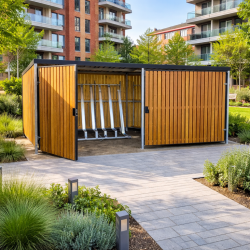
Transport Hubs are some of the most demanding environments for cycle storage. Train stations, bus terminals and park-and-ride facilities handle thousands of users per day, across all hours, in all weather. The bikes arriving at them range from basic hybrids to high-value e-bikes, and their users expect storage that is fast to access, genuinely secure and always available when they need it.
Standard cycle storage is rarely up to the job. High-traffic environments require a different level of thinking: capacity, security, layout and long-term durability.
At The Bike Storage Company, we work with transport authorities, developers and main contractors to deliver cycle storage for transport hubs that perform under sustained daily pressure. Here is what they require:
Why Transport Hubs Demand a Different Approach
Most cycle parking guidance is written with offices, residential schemes or schools in mind. Installing cycle storage for transport hubs present a unique set of challenges.
Volume is the first issue. A busy train station or bus terminal may need to accomodate hundred of bikes simultaneously with significant morning and evening peaks. A system that handles 50 spaces comfortably will not simply scale by adding more racks. Layout, circulation and access all need to be designed for the load from the outset.
Turnover is the second. Unlike a workplace bike store where bikes largely sit all day, transport hub users arrive and depart across multiple shifts. Short-stay and long-stay requirements often requirements often need to coexist in the same footprint. A commuter leaving their bike for eight hours has very different needs from a passenger locking up for 20 minutes.
Security expectations are higher. Bikes parked at transport hubs are often left unsupervised for extended periods and in publicly accessible locations. For high-value bikes, particularly e-bikes, basic Sheffield stand provisions simply do not provide sufficient protection. Theft at transport locations is a well-documented deterrent to cycling uptake, which means security specification has a direct impact on modal shift.
Finally, durability requirements are more extreme. Facilities that are exposed to weather, used repeatedly throughout the day and are often maintained by stretched facilities teams, need to be built to a standard that minimises maintenance over a long service life.
Capacity Planning
For transport hubs, capacity planning starts with understanding peak demand, not average demand. If the facility cannot absorb the morning peak, cyclists will park elsewhere or stop cycling for that purpose altogether.
LTN 1/20 provides a useful starting framework, but transport-specific locations often require modelling that goes beyond standard guidance. Key inputs include current and projected catchment population, existing and anticipated cycling mode share, walking distance from parking to platform and the split between short-stay and long-stay users.
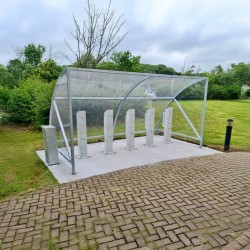
Space planning also needs to account for e-bikes. E-bikes are typically longer, heavier and require more manoeuvrability than standard bicycles. Aisles need to be wider and any two-tier provision must be specified to handle increased weight loads. E-bike charging provision must be increasingly expected, particularly for long-stay bays.
Planning for future demand matters too. A transport hub built today needs to accommodate cycling growth over a 15-20 year period. Oversizing at the outset is significantly cheaper than retrofitting later.
Choosing the Right Equipment
No single product type delivers the full range of equipment at a busy transport hub. A mix of solutions is almost always the right answer.
High-Capacity Bike Shelters
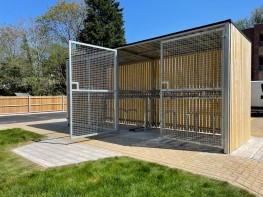
For outdoor provision, enclosed or semi-enclosed cycle shelters offer the best combination of weather protection, security and capacity. Access control via fob, key card or digital lock systems restricts users, which significantly reduces opportunistic theft. Shelters can be configured with two tier racks internally to maximise space efficiency within a constrained footprint.
Our shelter range includes options specifically suited to high-traffic locations, with anti-climb mesh, galvanised steel construction and configurations that accommodate a mix of standard and e-bike spaces.
Two-Tier Bike Racks
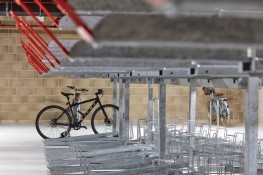
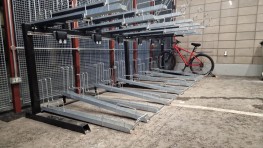
For high-capacity bike storage within covered or indoor environments, two-tier bike racks are the most effective solution. They double the number of spaces available within a given floor area, making them well-suited to constrained spaces.
Gas-assisted two tier racks reduce the physical effort of raising a bike to the upper tier, improving usability and reducing the likelihood of accidents or damage in a busy environment. This is a meaningful consideration for a facility where users may be rushing for a train.
Semi-Vertical Bike Racks
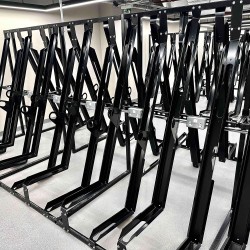
Where ceiling heights for floor space restrict the use of two-tier systems, vertical bike storage provides a practical alternative. Semi-vertical racks allow bikes to be stored at an angle, reducing the footprint per bike without requiring the physical effort of full overhead storage. They work well alongside sheltered areas or within existing concourse structures.
Bike Lockers
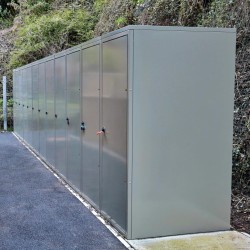
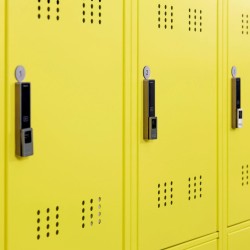
For long-stay users and high-value bikes, individual bike lockers provide the highest level of security available. Each unit is fully enclosed and independently lockable, with no shared access points. E-bike locker variants include integrated charging, making them suited to users who need their battery ready for the return journey.
Lockers are particularly effective cycle storage for transport hubs where allocated locker rental is a viable commercial model, as seen in many major UK rail stations and park-and-ride sites.
Getting the Security Right
Security specification for cycle storage at transport hubs should start from a threat assessment, not from a default product selection. Key questions include: how long are bikes typically left unsupervised? Is the location accessible to the general public or restricted to users? What is the recorded theft rate at or near the site?
For locations with an elevated security requirement, our Secured by Design range provides independently certified options across shelters, racks and stands. Products carrying Sold Secure Gold or Silver accreditation have been tested against a defined tool set and approved under the Police Preferred Specification, providing documented evidence of attack resistance.
Beyond product certification, access control, CCTV coverage, good lighting and clear sightlines all contribute to reducing risk. These are design considerations as much as product decisions and they need to be integrated from the start of a project.
Compliance and Sustainability
Cycle storage at transport hubs sits at the intersection of planning policy, active travel strategy and sustainability frameworks. Getting the specification right contributes across all three.
LTN 1/20 sets the quality benchmark for cycle infrastructure, including covered, secure and well-lit provision. The London Plan and many local authority transport strategies set specific minimum requirements for cycle parking at public transport hubs. BREEAM credits under Tra 03 and Tra 05 apply to commercial developments in proximity to or incorporating transport provision.
Our products are BREEAM-accredited and Made-in-Britain. We also provide full documentation to support planning applications and sustainability assessments, including specification sheets, CAD drawings and BREEAM statement templates.
Working With Us
The Bike Storage Company works with transport authorities, developers and project teams across the UK to deliver high-capacity, secure and compliant cycle storage for transport hubs. We support projects from initial capacity planning through to final installation, including site surveys, layout design and full documentation.
If you are looking for cycle storage for transport hubs, bus terminals or park-and-ride schemes, our team can help you identify the right combination of products and design the facility to perform under real-world demand.
Get in touch to discuss your project.

Related Products
| Height: | 2800 |
| Depth: | 2100 |
| Country of Origin: | UK |
| Material: | Accoya, Cedar, ... |
| Product Type: | Shelter |
| Finish(es): | Galvanised, Pow... |
| Bespoke: | 1 |
| Certifications: | BREEAM, FSC, IS... |

| Height: | 2500 |
| Depth: | 1800 |
| Country of Origin: | UK |
| Material: | Steel |
| Product Type: | Rack |
| Typical Building Sec...: | Domestic, Educa... |
| Finish(es): | Galvanised, Gal... |
| Bespoke: | 1 |
| Height: | 2500 |
| Depth: | 1900 |
| Country of Origin: | UK |
| Material: | Mild Steel |
| Bespoke: | 1 |
| Certifications: | BREEAM, ISO 140... |
| Typical Building Typ...: | Offices, School... |
| Warranty: | 10 |

| Height: | 1705 |
| Depth: | 1114 |
| Country of Origin: | UK |
| Product Type: | Rack |
| Typical Building Sec...: | Commercial, Edu... |
| Bespoke: | 1 |
| Typical Building Typ...: | Car Parks, Offi... |
| Width: | 305 |
| Height: | 1705 |
| Depth: | 1114 |
| Country of Origin: | UK |
| Product Type: | Rack |
| Typical Building Sec...: | Commercial, Edu... |
| Bespoke: | 1 |
| Certifications: | BREEAM, ISO 140... |
| Typical Building Typ...: | Car Parks, Offi... |
| Height: | 2500 |
| Depth: | 1800 |
| Country of Origin: | UK |
| Material: | Steel |
| Product Type: | Rack |
| Typical Building Sec...: | Domestic, Educa... |
| Finish(es): | Galvanised, Gal... |
| Bespoke: | 1 |

| Height: | 1200 |
| Depth: | 399 |
| Material: | Steel |
| Finish(es): | Galvanised, Pow... |
| Certifications: | BREEAM, ISO 140... |
| Width: | 300 |
| Above Ground Height: | 1200 |
| Colour: | Black, Blue, Gr... |
| BREEAM Description: | Secure enclosed... |
| Height: | 2100 |
| Depth: | 500-2100 |
| Country of Origin: | United Kingdom |
| Material: | Steel |
| Product Type: | Cycle Locker |
| Typical Building Sec...: | Commercial, Dom... |
| Finish(es): | Galvanised and ... |
| BREEAM Description: | Secure enclosed... |
| Height: | 1200 |
| Depth: | 600-1100 |
| Country of Origin: | United Kingdom |
| Material: | Steel |
| Product Type: | Cycle Locker |
| Typical Building Sec...: | Commercial, Dom... |
| Finish(es): | Galvanised and ... |
| BREEAM Description: | Supports sustai... |
| Height: | 2500 |
| Depth: | 2000 |
| Country of Origin: | United Kingdom |
| Material: | Galvanised Stee... |
| Product Type: | E-Bike Charging... |
| Typical Building Sec...: | Commercial, Dom... |
| Finish(es): | Galvanised stee... |
Contact

Contact
Contact