HOW SHOULD EXTERNAL WALLS BELOW DPC RESIST MOISTURE?
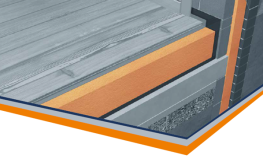
HOW SHOULD EXTERNAL WALLS BELOW DPC RESIST MOISTURE?
External walls below DPC require specific detailing. The junction of the wall with the ground floor construction must achieve continuity of insulation to meet the energy efficiency requirements of national building regulations, such as Part L 2021. At the same time, the choice of insulation solution must not compromise the building’s ability to resist moisture.
Part C of the Building Regulations in England, and specifically Requirement C2, sets out how buildings should resist moisture. It says a building’s floors, walls and roofs “shall adequately protect the building” from harmful effects caused by ground moisture, wind-driven spray and condensation. Technical guidance in support of Part C is published in Approved Document C for England.
What are the moisture resistance requirements in Wales and Scotland?
Thanks to the history of shared regulations in the two countries, the Building Regulations in Wales features the same requirement C2. At the time of writing, Approved Document C in Wales provides similar technical guidance to its counterpart in England. In future, however, the requirements and/or technical guidance could diverge.
Section 3 of the Scottish Building Standards, ‘Environment’, has its own moisture resistance requirements. Technical guidance in support of these requirements is published in the domestic and non-domestic technical handbooks.
Constructing external walls to resist moisture from the ground
Section 5 of Approved Document C gives guidance on how external walls can be constructed to resist moisture from the ground, and from outside the building (i.e., precipitation). Different guidance applies if the walls are subject to groundwater pressure.
For moisture from the ground, an external wall meets the requirement if it has a DPC that is continuous with any DPM in the floor (as described in section 4 of Approved Document C), and the DPC is a minimum of 150mm above the adjacent ground level.
If the external wall is of cavity construction then:
the cavity should continue down at least 225mm below the level of the lowest DPC; or
a “damp-proof tray” (cavity tray) should be provided to prevent precipitation passing to the inner leaf (with weep holes to aid the passage of moisture out of the wall through the external leaf).
This guidance begins to shape how we think about the specification of the wall below DPC level. However, we also need to keep in mind that there are specific requirements for the wall more generally, including above DPC level.
Constructing external walls to resist moisture from outside
Paragraphs 5.12 to 5.16 describe suitable outer leaf materials for cavity walls; what materials and components can bridge a cavity; and how exposure zones affect the width of clear cavity that should be maintained.
It also describes the conditions that thermal insulation must meet to be considered suitable for use in a cavity wall. In particular, rigid insulation boards “should be the subject of current certification from an appropriate body”.
Generally, that means an Agrément certificate issued by a third-party, which is usually the British Board of Agrément (BBA).
The question we must then ask is whether this requirement for the wall generally applies to the below DPC detailing. That is the subject of the next blog post.
Polyfoam XPS guidance on cavity wall specification below DPC
This is the first blog post in a series looking at the detailing of cavity walls below DPC level, and suitable insulation solutions to help meet both energy efficiency and moisture resistance requirements.
The second post asks: Does cavity wall insulation below DPC require a BBA certificate?
The third post looks at: Specifying and installing XPS insulation in cavity walls below DPC
All three posts are adapted from a Polyfoam XPS white paper examining below DPC insulation solutions in detail. The white paper addresses a wider need for information about this area of detailing, as specifiers look to ensure compliance

Contact

Contact
Contact