HOW DO EXTRUDED AND EXPANDED POLYSTYRENE COMPARE?
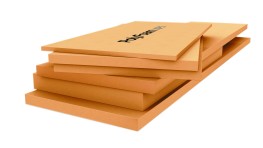
As both are types of polystyrene insulation, extruded polystyrene (XPS) and expanded polystyrene (EPS) are often seen as very similar. They tend to be viewed as more direct competition to one another than other types of rigid insulation like PIR and phenolic foam. While there are similarities in the applications for which XPS and EPS can be used, there are also substantial differences.
As thermal insulation products, XPS and EPS are most likely to be compared in terms of thermal performance in the first instance. They can be said to offer broadly similar thermal conductivities, which means product thicknesses for a given U-value will be similar. Although this contributes to the idea of them being direct equivalents, other performance characteristics must be checked carefully.
How are XPS and EPS made?
Manufacturing XPS insulation involves a two-stage extrusion process, after which the extruded foam is calibrated and profiled to create finished insulation boards. A recycling stage takes offcuts from the process and turns them back into polystyrene pellets, for use in later production runs.
You can read about this in more detail with our blog post looking at how Polyfoam XPS products are made.
In comparison, EPS insulation is made by applying heat or steam to a mould containing polystyrene foam beads. The beads expand and fuse together, although there are voids present.
Do XPS and EPS foam boards have the same resistance to moisture?
Like other rigid insulation boards whose performance is based on cells of trapped gas, XPS and EPS are classed as ‘closed cell’ materials that are resistant to vapour movement. They are also more ‘moisture resistant’ than open cell materials.
Moisture resistance is not a testable quality like vapour resistance; however, moisture absorption is. When a material absorbs moisture, the moisture replaces air and worsens the thermal conductivity, reducing the performance of the insulation layer. Establishing moisture absorption involves submerging samples in water and declaring the result as a percentage of the sample’s total volume.
The voids present in the structure of EPS foam mean that it has a relatively greater level of moisture absorption than XPS. This significant difference between the two polystyrene types is reflected in table 4 of BS EN ISO 10456:2007 Building materials and products. Hygrothermal properties. Tabulated design values and procedures for determining declared and design thermal values.
In situations where insulation could be exposed to moisture, its declared thermal performance must be adjusted by a moisture conversion coefficient. The standard’s table gives the conversion coefficient of XPS as 2.5, while EPS’s is nearly double that, at 4.
The typical moisture absorption of XPS is less than 1%, which means it can be exposed to wet environments and installed in direct contact with the ground.
How do XPS and EPS compare as floor insulation?
Both materials are offered as insulation for ground floor constructions, although it’s important to be sure that you are comparing like for like when looking at the available options.
Typical EPS solutions fall into a much wider range of performance than XPS solutions. For example, EPS can be offered with a compressive strength of anything from 70 kPa for domestic applications to 250 kPa for commercial and industrial applications.
By contrast, XPS solutions are usually offered with a compressive strength starting at around 200 kPa or 300 kPa, with up to 700 kPa possible.
These variations in compressive strength are not an issue, as long as the right material is selected for the right application. A perception we often encounter, however, is that XPS and EPS are essentially identical. A product is then selected purely on cost grounds, without taking the time to confirm that the compressive strength on offer is right for the intended project.
That same lack of attention to detail can also result in EPS being specified for installation below the damp proof membrane (DPM), when the differences in moisture absorption mean only XPS can be installed in this way. Read more about using XPS in the different types of ground floor construction defined by BS 5250.
How do XPS and EPS compare as inverted roof insulation?
Both XPS and EPS can be used as the thermal insulation layer in an inverted flat roof, although the range of applications is more limited for XPS.
This is primarily defined by a document called ETAG 031, which sets out the expected standard for insulation that should be used in the roof build-up. The starting point is either XPS manufactured to EN 13164, or EPS manufactured to EN 13163.
ETAG 031 allows XPS insulation with a 300 kPa compressive strength to be used for untrafficked and pedestrian roofs, as well as green roofs and roof gardens. It also refers to 500 kPa insulation for car park decks.
EPS insulation achieving 200 kPa is deemed suitable only for untrafficked and pedestrian roofs,
Because the overall thermal performance of an inverted roof takes into account the effect of moisture absorption, the declared thermal conductivities of both XPS and EPS must be corrected accordingly and an appropriate design lambda used as part of U-value calculations.
In what other applications can XPS and EPS be used?
The low moisture absorption of XPS makes it an excellent choice for use in below DPC detailing at the base of external walls. There are a host of other applications – some more surprising than others – in which people have chosen to put XPS to use.
EPS beads blown into existing uninsulated masonry cavity walls is a common retrofit measure. For new-build external walls, EPS products are available for both cavity wall insulation and external wall insulation – the latter where thickness is less critical and lower cost more desirable. A common use for EPS beyond the scope of building insulation, is void-filling material and other civil engineering applications.
About Polyfoam XPS
For more information about the performance characteristics of XPS, or for project support and U-value calculations for floor or flat roof build-ups, contact us.

Contact

Contact
Contact