Pitching a Green Roof
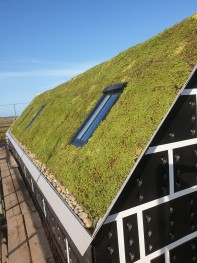
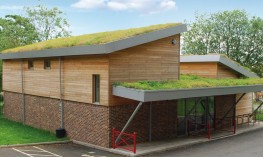
There are many benefits to having a green roof and in most cases the images that you will see will be flat roofs with shallow drainage falls. However, what happens when there is a pitched roof that requires a green roof? Can you actually install a green roof successfully on a sloping roof?
The answer to both of this question is yes, but it’s probably best to establish basic parameters first. A pitched green roof can be a monopitch, duo pitch, waveform, or a curved barrel roof. The roof should be continuously waterproofed and the actual surface of the roof level. The maximum pitch that a green roof can be laid at will vary depending on the configuration of the roof and the supplier but will generally be between 35 and 45 degrees.
Generally, a green roof with a slope of over 5 degrees is classed as a pitched roof. This might not seem much but the physics of a green roof in terms and how it performs will change above this pitch. Key considerations will be water management and managing the risk of slippage of the green roof build-up.
A green roof is normally classified as low pitch between 5 and 15 degrees although some manufacturers and suppliers may have a different range. In many cases the stability of the green roof build-up can be ensured without additional anti-slip provision at this pitch. In all cases a suitable structural detail needs to be provided at the base of the slope to contain the green roof. This can be either a kerb detail or a strengthened or bespoke edge trim both of which should allow for drainage provision. Factors that might dictate that anti-slip provision is needed, even at this pitch, are a slope length of over six metres and the waterproofing membrane used. A PVC or TPO single ply membrane, for example, will have lower slip resistance than a mineral surfaced reinforced bitumen membrane.
For a roof with a pitch in excess of 15 degrees an anti-slip function will normally be needed. To establish the correct solution, decide firstly where the transferred shear load is to be supported. Many anti-slip systems will ultimately transfer the load to the base of the slope, some will support the load from the top of the pitch. Once this has been decided, arrange for a shear load calculation to be carried out, either by the green roof system supplier or by a qualified engineer. If the shear load is to be transferred to the base of the slope a structural detail must be provided capable of accepting the load involved. For curved or barrel-vaulted roof areas there may different considerations as the roof pitch is not constant.
Anti-slip systems might involve intermediate sills, a grid or possible a specially designed or modified ant-slip board. It is preferable for whichever system is used for it to be as independent from the waterproofing system as possible. Improvised arrangements that include integral battens or sills fixed to the roof will need to be waterproofed separately and may introduce stress to the waterproofing membrane when the green roof build-up is in position and at its capacity in terms of water storage. They may also present a higher risk of water ingress or slippage of the green roof build-up due to failure of one or more of the sills in the future.
In summary, consider each pitched green roof project separately - there is no “one size fits all”. Ideally, consult with a green roof systems supplier that has expertise and experience in this area and can provide tried and trusted, purpose-made pitched roof solutions. Lastly, wherever possible work with a green roof installer who has experience with pitched green roofs. If you can do all this, you can have a very successful pitched green roof installation.

Related Products
| Average Weight: | 100, 120 |
| Water Storage Capaci...: | 25, 30 |
| Features: | Affordable and ... |
| Application: | Inverted roof |
| Item Type: | System |
| Build-up Depth: | from 120 mm, fr... |
| Vegetation Form: | Herbs-grasses-s... |
| Discharge Coefficien...: | 0.6, 0.7 |
Contact

Contact
Contact