Acoustic Floating Floors
by Farrat Isolevel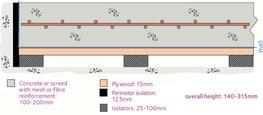
Modern floor designs tend to be lighter in weight and include longer spans, so therefore are more dynamic in nature. It is critical that designers consider disturbing frequencies and their harmonics as well as the natural frequency modes of the floor and structure. Structures can be tuned to minimise resonance effects or vibration control measures can be incorporated to provide vibration mitigation as well as enhance airborne and impact noise reduction. Incorporating a floating floor for noise or vibration isolation is often far more cost effective than the necessary increase in size/weight of Steel or concrete required to suitably stiffen a structure.
When aiming to minimise the effect of vibration induced on a floor, the fundamental natural frequency of the floor should be higher than the second harmonic of the representative normalised dynamic force of the activity taking place. However this is often at odds with requirements for noise and/or vibration isolation, where reducing stiffness increases performance. Therefore designing a floating floor with the correct natural frequency requires care and consideration.
Farrat’s Isomat and Jack up floating floors:
are used in buildings to protect sensitive areas from noise or to contain noise
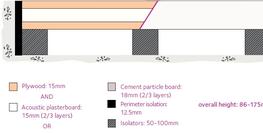
provide impact, shock and vibration control through a combination of mass addition and structural decoupling by constructing the floating slab on elastomeric or coil spring isolators tuned to specific frequencies
provide airborne noise isolation through the incorporation of an air layer between the structural slab and the floating slab
offer unparalleled flexibility in design, layout, acoustic and load carrying capacity
offer flexibility in delivery as well as being easy, fast and economical to install
Specification Details for Acoustic Floating Floors (Floating / Sprung Floors)
Please note that these product properties are not a replacement for the manufacturer's literature and it is always recommended that Farrat Isolevel is consulted before specifying.
 Other
Other
|
||
| Uniclass (?) | Ss_30_20_10 Board and rigid sheet floor systems | |
File Downloads for Acoustic Floating Floors

Similar Floating / Sprung Floors Products

Contact

Contact
Contact