Specifying Handrails for Greater Accessibility
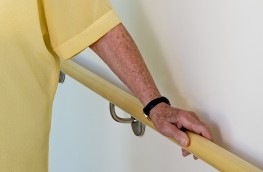
The Equality Act states that buildings must be accessible to all, regardless of disability, age or gender. In this article we will be looking at the design considerations to permit accessibility for those with physical mobility issues. The focus will be on handrails to assist those who have trouble walking.
A large number of people, especially the elderly, have mobility difficulties without needing to use a wheelchair. These people may use walking sticks and will find handrails very helpful within the building. In addition, in healthcare buildings, one needs to consider patients recovering from illness and operations. These patients may be very unsteady on their feet and need to use handrails for support in the early days of recovery.
Installing handrails will allow those with limited mobility to use a building safely and without risk.
Relevant Legislation
BS 8300 and Approved Document M set out detailed guidance regarding handrail specification. This guidance includes specific measurements and general usage guidance. Where the building is a healthcare facility, HBN 00-04 applies and these specifications take precedence over the guidance in BS 8300 and Approved Document M.
- According to the legislation, handrails should be:
- Easy and comfortable to grip with no sharp edges
- Provide adequate resistance to hand slippage
- Continuously graspable along the entire length without obstruction
- Finished so as to provide visual contrast with the surroundings. Guidelines suggest having a difference in Light Reflectance Value (LRV) of 30 points or more between the two surfaces.
- Strong enough to support users and fixed in a way that will support the required loading. At CS, we recommend fixing handrail brackets into studwork or pattresses, particularly where plasterboard wall construction is proposed.
- Terminated in a way that will reduce the risk of clothing or carried objects being caught potentially causing injury. For this reason return-to-wall end caps are recommended.
Recommended handrail dimensions:
- Circular handrails should be between 32mm and 50mm in diameter
- Oval shaped handrails should have dimensions of 50mm wide and 39mm deep with rounded edges and a radius of at least 15mm
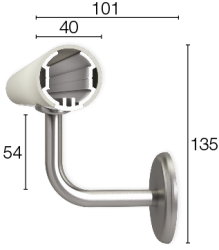
- Clearance from the wall to be between 50mm and 75mm (HBN 00-04 states 60-75mm)
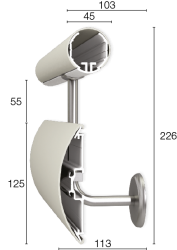
- Clearance from underside of rail to any cranked support to be 50mm minimum
- HBN 00-04: where handrails and wall protectors are provided on a single bracket, a minimum vertical clearance of 50mm must be maintained between the handrail and the wall protector.
Other considerations:
- In locations subject to extreme temperatures, handrails should be made of materials which do not become excessively hot or cold to touch.
- For heavy circulation routes and those subject to impact damage from mobile equipment, consider fitting crash protection in addition to handrails.
Acrovyn Handrails to Meet Accessibility Design Considerations
Acrovyn handrails from CS meet all the requirements set out in BS 8300, Approved Document M and HBN 00-04. The handrails are available in up to 27 different colours to accommodate visual contrast requirements, and a choice of materials including timber and stainless steel.
References
The Equality Act 2010 (incorporating the Disability Discrimination Act 1995) – View Document
BS 8300-2:2018 Design of an Accessible and Inclusive Built Environment Part 2: Buildings Code of Practice – View Document
Building Regulations Approved Document M: Access to and Use of Buildings – View Document
Health Building Note 00-04 – View Document

File Downloads
Contact

Contact
Contact