Safety Glass
by CN Glass, trading name of Chipping Norton Glass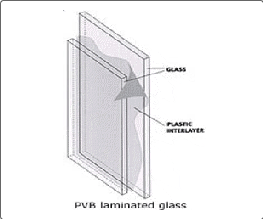
Achieved by heating annealed glass to approx 620°C within a furnace at which point it begins to soften, this is then cooled rapidly. When broken, Toughened Glass fractures into small pieces (called dice). As these particles do not have sharp edges and dagger points of normal broken glass it is generally regarded as Safety Glass.
Toughened Glass must be cut to a size and have any other processes (drilling, polishing etc.) completed before toughening because attempts to ‘work’ the glass after will cause it to shatter.
All installed safety glass should be clearly marked with the British Standard test reference BS6206, with the letter L for laminated, and T for toughened, together with the company registration number of the supplier.
Laminated Glass
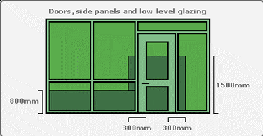
Manufactured by assembling two panels of glass which are sandwiched together with PVB. This is, therefore, a composite high-performance product which combines the material properties of the glass with the unique properties of PVB such as adhesion to glass, elasticity and impact resistance. This glass is particularly suitable where it is important to ensure the resistance of the whole sheet after breakage such as: Shop-Fronts, Balconies, Stair-Railings and Roof Glazing. Laminated glass can have electricity passed between the two panes of glass to make it activate an alarm, to heat the glass and to switch the glass from clear to opaque.
All installed safety glass should be clearly marked with the British Standard test reference BS6206, with the letter L for laminated, and T for toughened, together with the company registration number of the supplier.
Specification Details for Safety Glass (Glass)
Please note that these product properties are not a replacement for the manufacturer's literature and it is always recommended that CN Glass, trading name of Chipping Norton Glass is consulted before specifying.
 Materials & Finishes
|
||
| Material (?) | Glass | |
 Other
Other
|
||
| Uniclass (?) | Pr_25_71_33 Glass and glazing sheets and profiles | |
File Downloads for Safety Glass

Similar Glass Products

Contact

Contact
Contact