Foil - Metal Look Porcelain Tiles
by Ceramiche Refin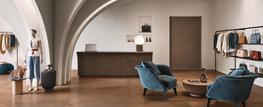
The fascination of crafted metal
Porcelain stoneware interprets metallic materials from various origins with a brand new styling effect. Aluminium, Titanium and Burnish are the result of observing a specific craft-based technique, specifically the one used by bending machine operators: the collection thus stands out for its markings and scorings originating by the hand-crafting processes. Corten and Verdigris on the other hand draw their inspiration from oxidised metals and replicate the ring marks and stains deriving from the action of rust and acids.
Porcelain Floor Tiles are made by materials featuring the lowest water absorption levels, which means the quantity of water that the slab can absorb under certain conditions.
Grès Porcelain stoneware is a ceramic with a compact, hard, coloured and non-porous body. The word “grès” means that the ceramic body of the tile is extremely vitrified, that is to say compact, hence the exceptional great resistance. The result is a lean clay body, little refractory, fired in a kiln (at 1200-1400 C°) until it reaches a non-porous vitrification and a complete water-proofing.
Amongst the most significant features of grès porcelain stoneware there is also the high abrasion resistance, which means the resistance of the surface against the action related to the movement of bodies, surface or materials in contact with it.
Specification Details for Foil - Metal Look Porcelain Tiles (Floor Tiles)
Please note that these product properties are not a replacement for the manufacturer's literature and it is always recommended that Ceramiche Refin is consulted before specifying.
 Commercial
|
||
| Application (?) | Flooring | |
| Typical Building Sector (?) | Commercial , Domestic , Hospitality | |
 Other
Other
|
||
| Uniclass (?) | Pr_35_93_96 Wall and floor tile units | |
 Materials & Finishes
 Physical Properties
File Downloads for Foil - Metal Look Porcelain Tiles

Contact

Contact
Contact