How Can Living Walls Help Meet Urban Greening Factor Targets?
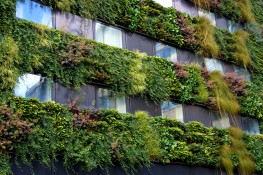
Urban greening is set to play an increasingly important role in making our cities healthier and better places to live, work and invest. Street trees, green spaces and buildings that have living walls all help to clean our air, reduce the risk of flooding and keep our cities cool.
In his 2021 ‘London Plan’, Mayor of London Sadiq Khan stated that major new developments must make urban greening a fundamental part of their site and building design, in a bid to create pleasant places for people to enjoy, increase biodiversity, improve air quality and attenuate rainwater.
All of this is incredibly positive and developers seem keen to embrace these new requirements. But how exactly is urban greening be measured? What targets do new developments need to meet? And what can developers do to ensure they meet these new targets?
Urban Greening Factor (UGF)
The Urban Greening Factor (UGF) is a planning tool designed to evaluate the quality and quantity of planting and green spaces in new development proposals.
Although it currently only applies to major applications in the Greater London area, it may well see it trickle down to smaller developments in the near future. It’s also likely to move beyond the capital as other UK regions start to adopt similar requirements.
The Greater London Authority (GLA) have been asking for Urban Greening Factor calculations since March 2021, meaning all large developments across the capital must now calculate their urban greening score.
Individual London Boroughs are able to tailor their Urban Greening Factor targets according to local needs and circumstances.
How is the score calculated?
Different types of green surface cover, such as flower rich planting, intensive green roofs or living walls are given weighted scores depending on their potential for rainwater infiltration and ecological value. Scores range from 0 for impermeable sealed surfaces, through to 1 for semi natural vegetation. The specific scores can be found in the official urban greening factor guidance.
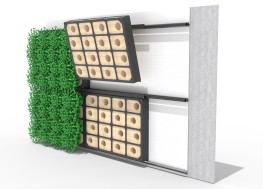
For example, green walls such as Biotecture’s BioPanel system have a factor of 0.6. The scores are then multiplied by the area covered.
Each score is added up and divided by the total site area. So a simplified calculation might look something like this:
Calculation (area x score) + (area x score) + (area x score) / Total Area
How can living walls help achieve UGF targets?
As we know, the amount of horizontal green space that can fit on a site is limited. Living walls on the other hand, allow us to utilise all of the development’s vertical surfaces.
As the UGF score is calculated using the total site area, adding vertical greening into the equation can lead to a significantly higher UGF score without taking up any more valuable horizontal space.
What’s more, using higher quality surface covers, such as those provided by Biotecture, will achieve a higher Urban Greening Factor score, again without increasing the overall footprint.
Can living walls satisfy other planning requirements?
Of course, the Urban Greening Factor is not the only planning requirement included in the London Plan. Measurable, long-term increases to biodiversity must also be demonstrated in development proposals, not to mention sustainable drainage.
The good news is, including more planting and green spaces such as living walls, which are sometimes call green walls, into schemes can help satisfy all these requirements.
It’s clear that when it comes to incorporating urban greening and achieving a high UGF score for your next development, living walls tick every box.
Find out more about Biotecture’s living walls here - www.biotecture.uk.com

Related Products
| Depth: | 62 |
| Height: | 450 |
| Weight: | 18 |
| Length: | 600 |
| Average Weight: | 75 |
| Certifications: | CWCT, WRAS |
| Location of Manufact...: | UK |
| Overall Depth: | 83 |
File Downloads
Contact

Contact
Contact