Efficiences in sluice room design
As one of the most common sources of preventable harm, healthcare-associated infections are among the leading threats to resident safety¹ and are common, costly and often fatal.²
Good infection prevention practices are vital to keeping residents and healthcare staff safe. So choosing the right equipment for human waste disposal processes is essential to minimise the transmission of preventable infections.³
The planning of a sluice room
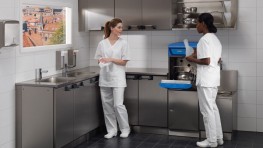
Planning the workspace is crucial when designing a sluice room, it should be equipped with a collection point for soiled goods, a hand washbasin, a flusher disinfector, and storage for clean goods. These are the four cornerstones to maintain good infection control routines. Clean hands on clean goods should be the dominant rule for all working procedures.
Eliminating the need for manual cleaning, flusher disinfectors effectively empty, clean, and disinfect receptacles such as bedpans, urinals and commode chair pans. Automated operation features such as infra-red door operation, to avoid contaminating the device exterior, can help to reduce the risk of cross-contamination while delivering highly effective cleaning and disinfection results. A well-planned sluice room, along with a good hand hygiene program, are both key to an effective infection control and prevention strategy.
In the sluice room, some additional considerations are as follows:
- Locate the soiled utility room close to point of care to avoid long transport routes
- Good ventilation is required to keep the room cool and dry, and to help remove odours
- Floors and walls should be made of a water-resistant material along with surfaces which are easy to clean and disinfect
- The hand washbasin should be placed close to the entrance and equipped with dispensers for soap and disinfectant, disposable paper towels and a waste paper bin. The mixer tap should be easily operated touch-free or with an arm / elbow
- Plan for sufficient power supply, hot and cold-water inlets, and suitable drainage for the flusher disinfector, sink and slop hopper (optional)
Minimising caregiver exposure to human waste during its disposal in the sluice room is fundamental. Caregivers can be exposed to splashes and aerosols⁴ during manual cleaning of bedpans and urine bottles or when emptying waste, which can lead to caregiver illness or cross-infection with residents. For this reason, having an efficiently designed sluice room, flusher disinfector and an efficient waste management process are key to minimise the risk of cross-infection.
References:
- Ahrq.gov, 2021. AHRQ’s Healthcare-Associated Infections Program. Available at: www.ahrq.gov/hai/index.html accessed June 2022
- European Centre for Disease Prevention and Control. 2018. Healthcare-associated infections: Clostridium difficile infections. ECDC. Annual epidemiological report for 2016. https://www.ecdc.europa.eu/sites/default/files/documents/AER_for_2016-C-difficile_0.pdf accessed June 2022
- Arjo Clinical Whitepaper. Flusher Disinfectors: Reducing the risk of cross contamination, 2019
- Knippenberg-Gordebeke, G., 2012. Bedpans and healthcare-associated infections - Hospital Healthcare Europe. Hospital Healthcare Europe. https://www.hospitalhealthcare.com/news/bedpans-and-healthcare-associated-infections/ accessed June 2022

Related Products

| Depth: | 580 |
| Height: | 1320 |
| Weight: | 90 |
| Width: | 450 |
| Noise Level (dBa): | 53 |
| Connection Diameter: | 15 |
| Temperature: | 40 |
| Uniclass: | Pr_40_70_51 Med... |

| Depth: | 620 |
| Height: | 870 |
| Weight: | 90 |
| Width: | 450 |
| Noise Level (dBa): | 53 |
| Connection Diameter: | 15 |
| Temperature: | 40 |
| Uniclass: | Pr_40_70_51 Med... |

| Depth: | 580, 620 |
| Height: | 870, 1320 |
| Weight: | 100, 120 |
| Width: | 450, 900 |
| Noise Level (dBa): | 53 |
| Product Type: | Flusher Disinfe... |
| Features: | Cooling fan, Ef... |
| Min Pressure: | 1 |
Contact

Contact
Contact